In which era did mammoths live?
Mammoths dominated large regions of the planet for millions of years, from the Pliocene until the end of the Pleistocene, and some survived in isolation until the Holocene. Their history spans geological eras marked by cooling and vegetation changes that shaped their evolution and distribution.
Their origin dates back to the late Pliocene, about five million years ago, when the first members of the genus Mammuthus appeared in Africa and Asia. From there they spread across Eurasia and North America, adapting to diverse climates and landscapes.
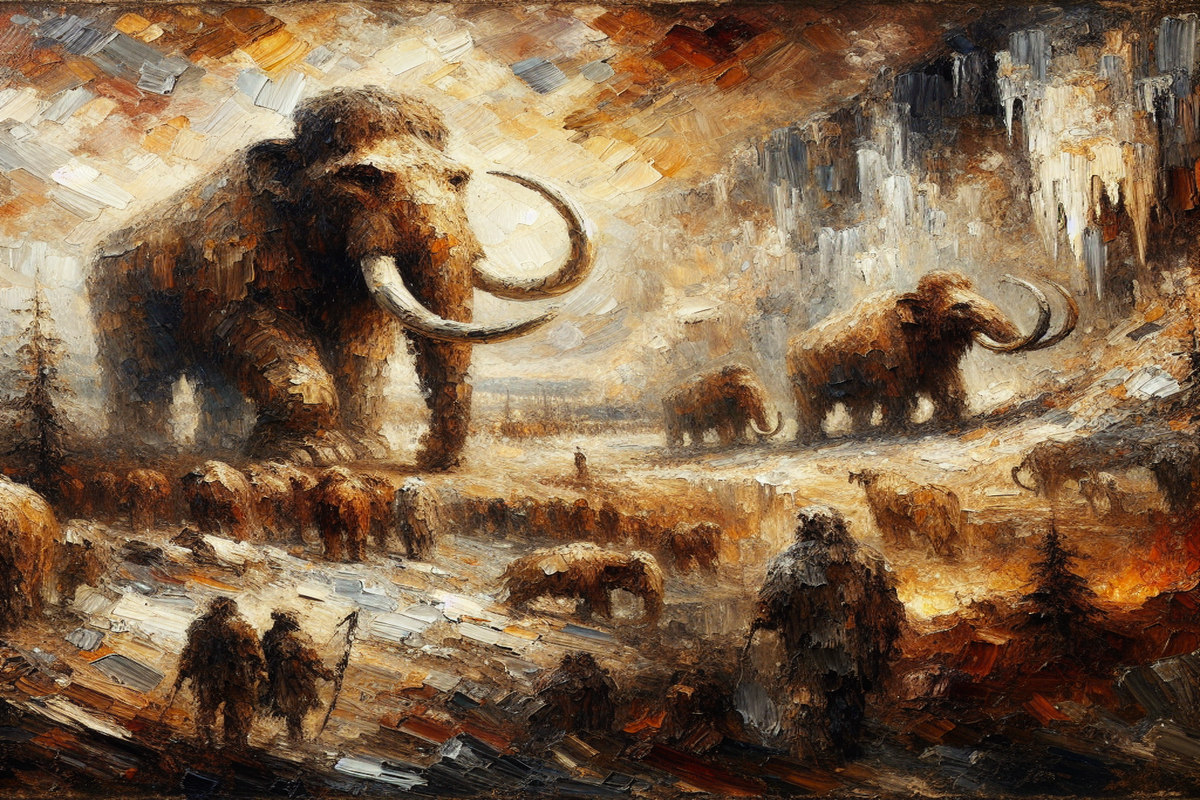
During the Pleistocene, repeated glaciations altered ecosystems, creating cold grasslands and steppes that benefited several mammoth species. That era is commonly associated with the woolly mammoth, an icon of ice and the northern tundra.
Origin and evolution
Mammoths evolved from primitive proboscideans, a group that includes the ancestors of modern elephants. Changes in size, tusk shape, and fur reflect adaptations to cold climates and varied diets.
Evolutionarily, species such as Mammuthus meridionalis, Mammuthus trogontherii, and Mammuthus primigenius show a progression of traits toward greater robustness and cold adaptation. These transformations occurred over millions of years, with multiple branches and local extinctions.
The Pliocene, the emergence
In the Pliocene the foundations of the mammoth lineage were established, with warmer environments that later gave way to climatic oscillations. Expansion into high latitudes began then, favored by the availability of extensive grasses in open areas.
The transition from the Pliocene to the Pleistocene involved cooling that expanded cold steppes, a setting in which mammoths thrived for hundreds of thousands of years. Their populations increased in Eurasia and the Americas when conditions were favorable.
The Pleistocene, the age of mammoths
The Pleistocene is the period when mammoths reached their maximum diversity and distribution, from the plains of Siberia to the grasslands of North America. Glaciations favored megafauna adapted to cold and extensive grasslands.
Between 2.6 million and 11,700 years ago, successive glaciations and interglacial periods controlled the expansion and contraction of populations. Woolly mammoths, for example, adapted with dense fur, thick fat layers, and reduced ears.
Relevant species and their chronology
The best-known species include the woolly mammoth, Mammuthus primigenius, common in the cold northern regions; the Columbian mammoth, Mammuthus columbi, present in North America; and larger ancestors like Mammuthus meridionalis. Each had its own temporal and geographic range.
For those seeking size comparisons and fossil records, we have covered related topics in entries such as which was the largest mammoth and the woolly mammoth: exploring life and extinction.
Extinction, a disappearance in stages
The extinction of mammoths was not a single event; it was a staggered process. On the main continents most disappeared between 13,000 and 10,000 years before present, coinciding with the end of the Pleistocene and major changes in climate and vegetation.
However, isolated populations persisted for millennia, such as those on Wrangel Island in the Arctic, which survived until about 4,000 years ago. For the causes, we invite you to read our entry on how mammoths became extinct.
Factors that drove the extinction
Explanations combine climatic warming, habitat loss, changes in plant composition, human hunting, and possible diseases. The retreat of cold steppes reduced key resources, and human pressure coincided with the decline of fragmented populations.
Studies of remains and dating show that in many places the disappearance was rapid once populations became small and isolated. Paleontological and genetic evidence helps to understand these processes.
Fossil evidence and dating
Fossils, from bones to quantities of hair and DNA preserved in permafrost, allow dating of individuals and populations. Techniques like radiocarbon dating help place events in time and reconstruct regional chronologies.
On methods and findings, at the Museo del Mamut we have worked with materials that illustrate how the age of remains is determined, and we have published related articles, for example dating of fossils and fossils: remains that reveal the past.
Where mammoths lived
Mammoths occupied cold and temperate regions of Eurasia and North America, adapting to tundras, steppes, and areas with grasslands. In Mexico and North America they left traces in fossil records that show their range and migration routes.
If you are interested in distribution, we have also addressed the topic in where mammoths lived, with maps and explanations about habitats by species and period.
Records in Mexico and local relevance
In Mexico remains have been found that enrich the narrative of Pleistocene megafauna and its interaction with early humans. These discoveries connect the global history of mammoths with regional and cultural contexts.
The Museo del Mamut of Tultepec presents pieces and exhibits that contextualize these findings, linking paleontology with local traditions and showing how megafauna influenced ancient landscapes and societies.
What science continues to learn
Paleontology advances with new ancient DNA techniques, tomography, and climate modeling that refine chronologies and relationships between species. Each discovery re-evaluates details about when and how mammoths lived.
To explore modern methods, we recommend reading our pieces on paleontology and tomography studies, such as tomography of a woolly mammoth.
Connection between past and present
Understanding when mammoths lived is not only about placing them on a time scale; it is recognizing how environmental changes affected biodiversity. Their history offers lessons about resilience and the risks posed by climate change.
At the Museo del Mamut of Tultepec we aim to bring those lessons to the public by integrating research, exhibition, and outreach to link science and local identity.
Visit and resources
Those who wish to see replicas, fossils, and scientific explanations can visit our halls, where we combine museum displays with accessible information. Our archive and exhibitions keep the dialogue between past and present alive.
In addition to exhibits, we publish articles that expand each topic, for example on extinct megafauna and cave paintings, and on how pyrotechnics and local tradition interact with the natural heritage of Tultepec.
Conclusion
Mammoths lived primarily during the Pliocene and Pleistocene, with occasional survivals into the Holocene in isolated populations. Their history is complex, illustrated by fossils, DNA, and changing landscapes that we now preserve and study in institutions such as the Museo del Mamut in Tultepec.